

Ball bearings are among the most critical components powering India’s industrial machinery — yet they rarely receive the strategic attention they deserve in procurement planning. As India accelerates its Make in India push in 2026, domestically sourced, quality-certified bearings have moved from a technical footnote to a national industrial priority.
What Is a Ball Bearing? A Quick Technical Foundation
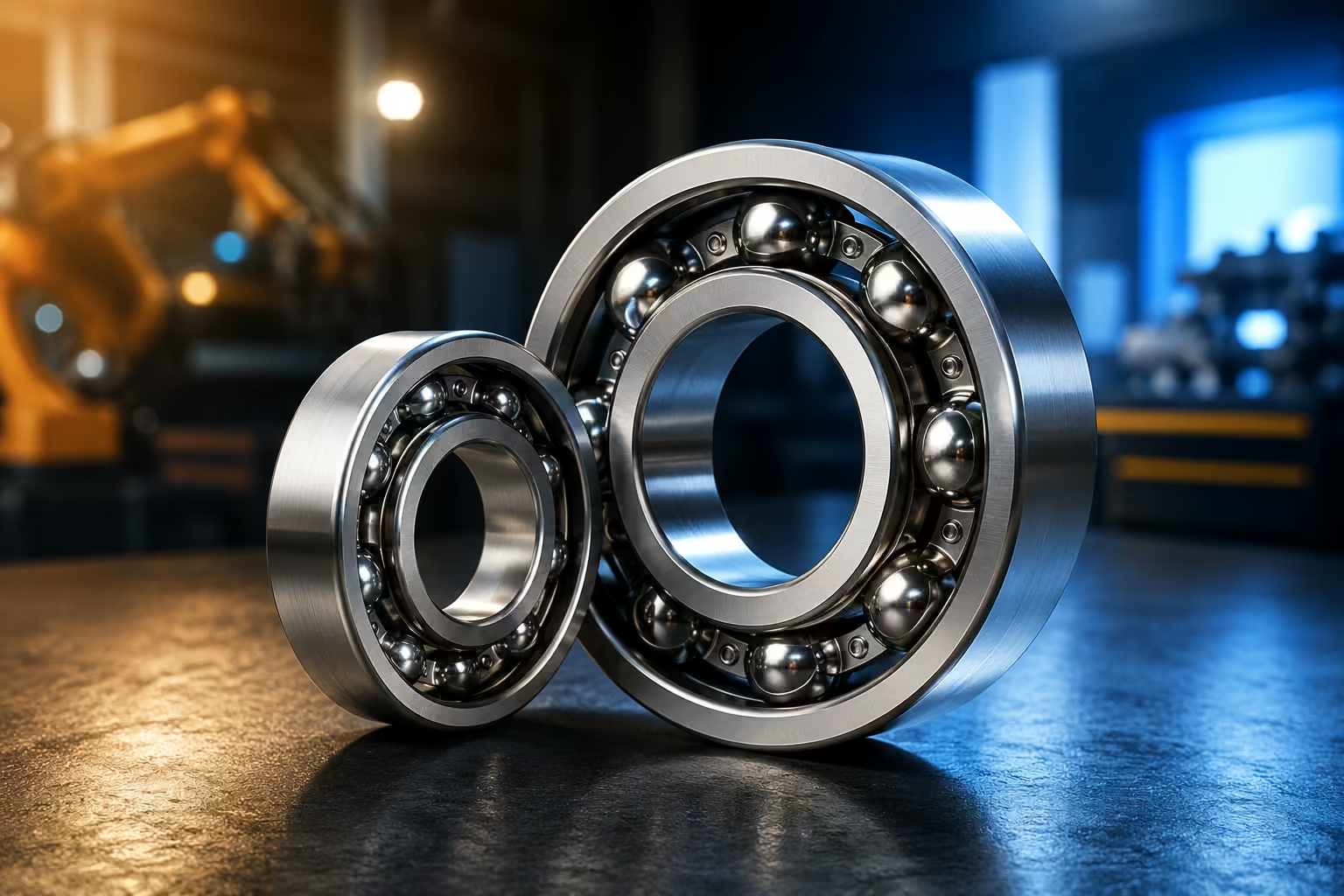
A ball bearing is a precision mechanical component that reduces rotational friction and supports radial and axial loads between two moving parts — a shaft and a housing — using a series of hardened steel balls running between inner and outer rings. In plain industrial terms, ball bearings are what allow machines, motors, conveyors, pumps, and heavy equipment to spin smoothly without generating destructive heat or mechanical wear.
The basic anatomy of a ball bearing includes:
- Inner ringRotates with the shaft
- Outer ringFixed to the housing or housing bore
- Steel ballsPrecision-graded rolling elements that reduce contact friction
- Cage/retainerSeparates and guides the balls evenly around the raceway
- Seals or shieldsProtect internal components from dust, moisture, and contamination
For industrial applications across automotive, mining, cement, steel, agriculture, and heavy engineering sectors, the quality of ball bearings directly determines equipment uptime, maintenance cycles, and total cost of ownership.
India’s Industrial Landscape in 2026: Why Ball Bearings Matter More Than Ever
India’s manufacturing sector is expanding at an accelerating pace in 2026, driven by government-backed infrastructure investment, the Production Linked Incentive (PLI) scheme across fourteen priority sectors, and a decisive shift toward sourcing industrial components domestically rather than relying on imports.
The Indian bearings market is one of the fastest-growing segments in the global industrial components space. Key demand drivers include:
Automotive & Commercial Vehicle Sector
India remains one of the world’s largest vehicle markets, with OEM and aftermarket demand for precision bearings growing year-on-year.
Infrastructure & Construction
Heavy machinery, crushers, material handling equipment, and construction equipment all run on high-load bearings.
Railway Modernization
India’s rail expansion program requires bearings for traction motors, axleboxes, and wheel assemblies.
Agriculture Mechanization
Tractors, agri-hub assemblies, and harvesting equipment use deep groove ball bearings and specialized agricultural bearings.
Steel, Cement, & Mining
Continuous process plants running around the clock demand bearings designed for extreme load, heat, and contamination conditions.
How Make in India Is Reshaping Bearings Procurement
Domestic Manufacturing Credentials
Procurement teams in government-linked industries, defence manufacturing, railways, and public sector heavy engineering are actively preferring suppliers with verified domestic manufacturing or locally audited supply chains. KGTI supports this requirement through a manufacturing network that includes production facilities in India and China, regularly audited and inspected by dedicated offices in both countries — ensuring quality at source, not just at delivery.
Faster Delivery and Stock Availability
Import-dependent supply chains expose plant managers to long lead times, customs delays, and currency risk. KGTI addresses this with a large and easily accessible stock point in Bhiwandi, Maharashtra — one of India’s most strategically located logistics hubs — enabling faster replenishment across industrial clusters in Maharashtra, Gujarat, Rajasthan, and beyond.
Traceability and Quality Documentation
Make in India procurement increasingly requires traceable components. KGTI’s KG Colorful and KG P2P bearing ranges carry full bearing numbers with factory codes and quality codes on markings, enabling complete traceability from production to application. Quality testing reports are available to support procurement validation for OEM and institutional buyers.
Application Engineering Over Guesswork
A critical shift in 2026 is away from catalogue buying and toward application-led procurement. KGTI supports this through application engineering assistance — helping procurement managers, maintenance engineers, and OEM design teams identify the right bearings for their specific operating conditions, load profiles, speed requirements, and environmental challenges.
KGTI’s Bearing Range: Built for Indian Industrial Demands
KGTI offers a comprehensive range of ball bearings and roller bearings designed to serve the full spectrum of Indian industrial and commercial vehicle applications. The KG Bearings portfolio is organized into five performance variants:
| Variant | Positioning | Best For |
|---|---|---|
| KG Blue | Economical, good quality | Aftermarket, general industrial MRO |
| KG Colorful | Premium aftermarket with traceability | Aftermarket buyers needing quality-price balance |
| KG Ultra | Large-size, heavy-industry grade | Steel, cement, mining, crusher, material handling |
| KG P2P | High-precision OEM/end-user grade (P6, ABEC3) | OEM sourcing, high-load and high-speed applications |
| KG-E | Premium low-noise radial ball bearings | Low-noise, high-precision, demanding environments |
Types of Ball Bearings
Ball bearing types available from KGTI include:
- Deep Groove Ball BearingsThe most widely used bearing type, suitable for automotive, agriculture, pumps, compressors, and general machinery.
- Miniature Ball BearingsFor compact machinery, instrumentation, and home appliances.
- Angular Contact Ball BearingsFor applications requiring combined radial and axial load handling.
- Self-Aligning Ball BearingsDesigned to accommodate shaft misalignment in agricultural and industrial machinery.
For heavy industry, the KG Ultra range extends to spherical roller bearings, Tapered Roller Bearings, cylindrical roller bearings, thrust bearings, plummer blocks, and adapter sleeves — making KGTI a single-source supplier for plant maintenance teams managing diverse machinery.
Industries Where Ball Bearings Are Most Critical
Automotive and Commercial Vehicle
Ball bearings and Tapered Roller Bearings are used throughout vehicle drivetrains, wheel assemblies, gearboxes, alternators, and engine auxiliaries. As India’s automotive OEM base expands, the demand for precision, traceable bearings from reliable suppliers is growing rapidly.
Agriculture and Agri-Mechanization
India’s push toward farm mechanization depends on reliable bearings for tractors, threshers, agri-hub assemblies, and irrigation pumps. Bearings here face unique challenges — dust, moisture, load variability, and seasonal stress.
Heavy Machinery, Mining & Crusher
India’s infrastructure sectors demand bearings that can withstand extreme radial loads and contaminated environments. The KG Ultra range is designed for these conditions, with wider lubrication grooves and P0/P6 requirements.
Steel, Cement, & Process Industries
Continuous process plants running around the clock demand bearings designed for extreme load, heat, and contamination conditions.
Industrial Efficiency and Reliability: Regardless of industry, ball bearings are a primary lever for improving industrial efficiency. Research consistently confirms a direct correlation between bearing quality, correct selection, and machine uptime — as explored in KGTI’s technical resource: Are Ball Bearings and Industrial Efficiency Correlated?
What to Look for in a Make in India Ball Bearing Supplier
Manufacturing auditability
Can the supplier provide documentation of factory quality controls, inspection processes, and material standards (GCr15/SAE 52100 chrome steel)?
Traceability
Does each bearing carry a full bearing number, factory code, and quality code that can be traced back to production?
India-based stock
Does the supplier maintain verifiable inventory in India, with realistic lead times for critical MRO replenishment?
Application engineering support
Can the supplier assist in selecting the right bearing for a specific machine, load condition, and operating environment?
Range breadth
Does the supplier cover the full spectrum of bearing types needed across plant operations?
Technical documentation
Are quality test reports, product specifications, and catalogue data available for procurement validation?
KGTI meets these criteria through a combination of a 53-year KG group bearing legacy, dedicated quality offices in India and China, the Bhiwandi logistics hub, application engineering support, and a comprehensive product portfolio spanning KG Blue through KG-E. For procurement teams evaluating suppliers, the resource Things to Consider Before Appointing a Bearing Supplier in India offers a practical starting framework.
The Science Behind Ball Bearing Quality: What Material Standards Mean for Indian Buyers
One of the least understood aspects of ball bearing procurement is material science. For Indian procurement managers navigating Make in India sourcing decisions, understanding the basics of bearing material standards helps separate quality suppliers from low-cost alternatives with unverifiable origins.
- GCr15 (SAE 52100) chrome steelis the global benchmark raw material for industrial ball bearings. KGTI uses GCr15 across the KG Bearings range, ensuring consistent hardness, fatigue resistance, and dimensional stability.
- Ball grade G10— used across KGTI’s range — refers to a precision level where ball diameter variation is controlled within 0.25 micrometers, directly impacting noise, vibration, and bearing life.
- Precision class P0 (ABEC1)is standard across KG Blue and KG Colorful for general-purpose and aftermarket use, while P6 (ABEC3) is used in KG P2P and KG-E for OEM and precision applications.
- Radial clearance control— KGTI applies roller grouping tolerances of 10–15 micrometers across standard ranges and 5–10 micrometers for the KG Ultra heavy-industry range, ensuring correct preload and load distribution in service.
These material and manufacturing parameters are not visible on a product label — which is precisely why working with a technically credible supplier who can provide documentation and explain selection parameters matters.
Explore the technical science: Ball Bearing Science: Outer Ring and Contact Angle Alignment
How KGTI Supports Make in India Beyond the Product
KGTI’s role in India’s industrial growth extends beyond supplying bearings. The support ecosystem that KGTI offers is designed for the realities of Indian industrial operations:
Helping teams select bearings for specific machines and operating conditions, reducing the risk of misapplication and premature failure
Providing documentation that meets institutional and OEM procurement requirements
Equipping maintenance teams and channel partners with the knowledge to select, install, and maintain bearings correctly
Supporting procurement teams working within structured budgets and MRO procurement frameworks
KG SMART SUPPORT
KGTI has initiated KG SMART SUPPORT to support maintenance-focused industrial and heavy machinery requirements, which may include online condition monitoring, offline condition monitoring for low-moving machines, KG Maintenance Assessment, and lubrication-led support through KG Ultra Grease where relevant
For industrial plants and OEMs that need more than a product catalogue, KGTI positions as a dependable industrial partner — a distinction that procurement managers and plant reliability teams increasingly prioritize in 2026.
Frequently Asked Questions
Connect with KGTI for Application-Specific Bearing Guidance
For procurement managers, maintenance engineers, OEM sourcing teams, and plant operators seeking quality-certified bearings for Indian industrial applications, KGTI supports application suitability evaluation, technical documentation, and product selection across the full KG Bearings range.
Share your bearing number, equipment type, operating conditions, or application requirement with the KGTI team for guided selection support.
KG Technologies India Pvt. Ltd.
- 402-403, DLF Towers, Shivaji Marg, New Delhi – 110015
- +91-11-49041324 / 49041325
- info@kgindia.co.in
- www.kgindia.co.in
Product selection depends on application conditions, operating environment, load, speed, temperature, maintenance schedule, and equipment requirements. Buyers should consult KGTI for application suitability before final selection.